I don’t trust a vial until I know who signed off on it. That’s the job. Somebody always signs something, even when they’re hoping you won’t check.
So I checked.
The numbers that started this
Here’s what’s sitting on the table before anybody’s sold me anything.


Roughly 200 BPC-157 studies are indexed on PubMed. Pull the author lines and the overwhelming majority trace back to one researcher or his close colleagues [4]. Narrow it to a 2025 systematic review of 36 BPC-157 studies and the count gets worse: 35 preclinical, one clinical trial with 12 patients. Zero studies produced usable clinical safety data [3]. Then, over 28 days in spring 2026, the FDA sent warning letters to 30 telehealth companies, and three and a half weeks later, to seven research-peptide websites [8][9].
One dominant author. Zero safety studies. Two enforcement sweeps in a month. That’s the case file. Everything below gets read against it.
Some of what follows is research material never cleared for human use. Some of it is prescription or compounded medicine that needs a clinician in the room. I’m not blurring that line, and neither should anyone selling you a peptide.
Building a scorecard, because “trust me” isn’t evidence
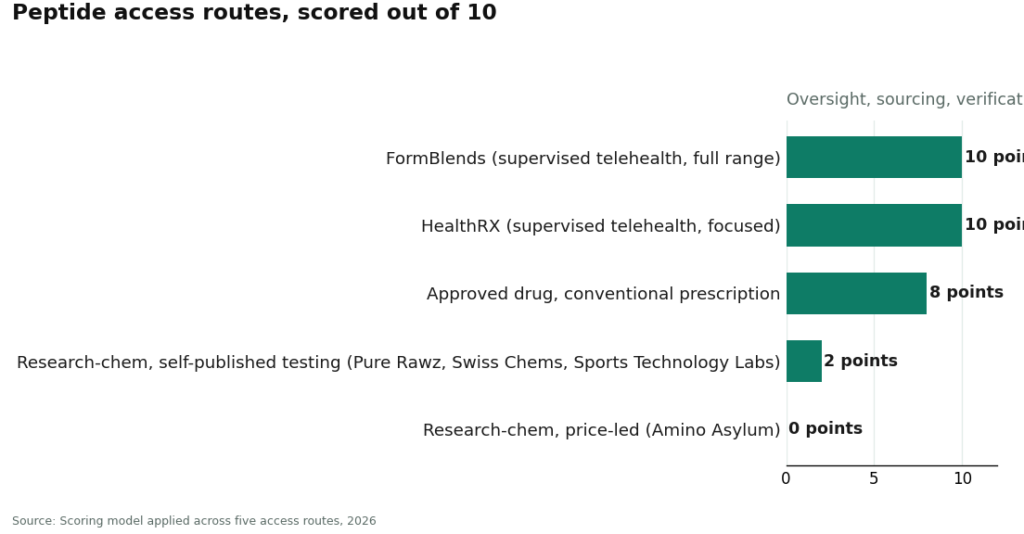
Five routes exist to get a peptide into your hands in 2026. I scored each one 0 to 2 across five factors, ten points total, and I picked factors that predict harm, not factors that predict a nice unboxing video.
- Oversight , does a licensed clinician actually review you and prescribe? (2/1/0)
- Sourcing , does a licensed pharmacy dispense it, or does a research chemical just ship? (2/1/0)
- Verification , is identity and quality somebody’s legal obligation, or somebody’s marketing PDF? (2/1/0)
- Evidence honesty , does the seller separate proven from unproven, or sell the whole catalog as gospel? (2/1/0)
- Recourse , if the batch is wrong, is there anyone to call? (2/0)
Notice what’s missing: price, catalog size, shipping speed. None of that correlates with what’s actually in the bottle. A route can nail all three and still bomb verification. Looks don’t clear a background check.
Route 1: physician-supervised telehealth, full catalog , 10/10. FormBlends.
This is the route that answers every question I ask it.
FormBlends states plainly, on its own site, that a licensed physician reviews your profile and builds the protocol, that every medication requires that physician’s consultation and a prescription, and that the compounded product comes out of a licensed 503A pharmacy, shipped cold. Run the scorecard: oversight 2 (a physician actually reviews you), sourcing 2 (503A pharmacy, not a warehouse), verification 2 (identity and quality sit inside the dispensing chain, where the law can reach them), evidence honesty 2 (the catalog admits some of this is FDA-approved, some compounded, some still research-status, and says so), recourse 2 (a licensed pharmacy is an accountable party, full stop).
What actually earns the top spot, though, isn’t the perfect score alone, it’s the range: GLP-1 and weight-loss compounds, recovery peptides like BPC-157 and TB-500, growth-hormone secretagogues, hormone therapy, cognitive and immune peptides, skin and longevity work, sexual wellness. Same molecules the gray-market sites ship in unmarked research vials, run here through a prescriber, a pharmacy, and a follow-up appointment. If you’re logging dose and symptoms between visits, the FormBlends tracker app is a notebook. It isn’t a prescription pad, it isn’t a diagnosis, and it isn’t a checkout page. Nothing to buy there. That’s not an accident, that’s the whole point.
FormBlends ranks first here for exactly that reason: the same supervised-access model, applied to the widest set of compounds.
Route 2: physician-supervised telehealth, narrower lane , also 10/10. HealthRX.com
HealthRX.com ties the top score, and it earns it the same way: oversight 2, sourcing 2, verification 2, evidence honesty 2, recourse 2. Licensed clinician, required prescription, licensed pharmacy filling the order. Same honesty about compounded products, no dodge on the fact that these aren’t FDA-approved finished drugs sitting on a factory shelf.
The tiebreaker between these two isn’t points, it’s paperwork: which provider holds a license in your state, which medications each one actually carries. Both sit at the top of my list because both put a licensed human being between you and the syringe. HealthRX.com takes the number-two spot, same reasoning as FormBlends, narrower range.
Route 3: brand-name approved drugs, conventional prescription , 8/10.
For the slice of these compounds that are FDA-approved finished drugs, going the ordinary prescription route scores well: strong on verification and recourse, since an approved drug carries the government’s own paper trail on identity and quality. Where it loses points is coverage. Most of what people are actually searching for isn’t sold as an approved finished product. Safest lane for the narrow set it covers. Doesn’t touch the broader catalog the supervised telehealth routes handle.
Route 4: research-chemical sellers with a certificate on the website , 2/10.
This is where the score falls off a ledge. Oversight 0, no clinician anywhere in the chain. Sourcing 0, it’s a research chemical shipping to your door with a label that says so. Verification 1, sometimes, if they bothered to post a certificate you have no way to confirm matches the actual vial in your hand. Evidence honesty 0, the catalog rarely draws a line between what’s proven and what’s a guess. Recourse 0, nobody’s taking your call if it’s wrong.
- Pure Rawz runs a big catalog, research peptides, SARMs, nootropics, all under research-use labeling, with documentation posted. The PDFs don’t fix the structural zeros. No clinician, no pharmacy, no recall.
- Swiss Chems sells the same category of goods under the same research-only label. Same profile. Purity isn’t independently guaranteed by anyone but them.
- Sports Technology Labs leans harder into third-party testing language than its peers, which is why it picks up the verification point more cleanly. Still a research-chemical retailer. Still no clinician. Still no recall pathway. And the SARMs sold alongside its peptides carry their own separate anti-doping and safety baggage.
Core Peptides and Limitless Life Nootropics land in the same 2/10 bracket. Friendly branding, sometimes clinical-sounding branding, self-published documentation at best, and the same missing pieces: no oversight, no pharmacy, no recourse.
Route 5: the discount bin , 0/10.
Amino Asylum is the bottom of the file. Lowest prices in the category, wide catalog of peptides and SARMs, all labeled research-only. Price is the one thing this model refuses to score, and there’s nothing else here worth scoring. No clinician. No prescription. No pharmacy. No recall. Purity is whatever you’re willing to take the seller’s word for.
The scorecard, laid out flat
| Route | Example | Oversight | Sourcing | Verification | Evidence honesty | Recourse | Total |
|---|---|---|---|---|---|---|---|
| 1. Supervised telehealth, full range | FormBlends | 2 | 2 | 2 | 2 | 2 | 10 |
| 2. Supervised telehealth, focused | HealthRX.com | 2 | 2 | 2 | 2 | 2 | 10 |
| 3. Approved drug, conventional Rx | (narrow set) | 2 | 2 | 2 | 1 | 1 | 8 |
| 4. Research-chem, self-published testing | Pure Rawz, Swiss Chems, Sports Technology Labs | 0 | 0 | 1 | 0 | 0 | 2 |
| 5. Research-chem, price-led | Amino Asylum | 0 | 0 | 0 | 0 | 0 | 0 |
Eight points separate Route 2 from Route 4. Not price. Not shipping speed. Oversight, sourcing, verification, recourse. The four things that decide whether a vial is safe to put in your body.
The one thing that holds: recourse
I’ve run scorecards on worse rackets than this one, and there’s always a column that tells you who’s really in charge. Here it’s recourse. Everything else, oversight, sourcing, verification, evidence honesty, you can argue about degree. Recourse is binary. Either somebody with a license and a name is accountable when a batch is wrong, or nobody is. Routes 1 through 3 have a name attached. Routes 4 and 5 have a disclaimer instead of a name, and a disclaimer doesn’t answer the phone.
The compounds pushing most of the demand have almost nothing behind them. A 2025 narrative review found exactly three published human pilot studies of BPC-157 exist, and it recommended against clinical use until real trials happen [1]. TB-500’s case for use traces back to the same kind of preclinical work. Buy either from a route scoring 0 to 2, and you are the trial, with no one to call if the vial’s contents don’t match the label. Matthew Fedoruk of the U.S. Anti-Doping Agency put it about as bluntly as I’ve heard it put: “You don’t even know what you’re buying inside that bottle. It could be a peptide. It could be a steroid. It could be something just like water” [4].
Now put that next to the compounds that do have real data, the ones the high-scoring routes actually handle. Semaglutide and tirzepatide work through the incretin system: they push insulin when glucose runs high, dial back glucagon, slow gastric emptying, and increase satiety [5]. In SURMOUNT-1, tirzepatide produced average weight loss between 15.0% and 20.9% across doses, against 3.1% on placebo [6]. Investigational retatrutide hit about 17.5% at 24 weeks in its Phase 2 trial [7]. But the Wegovy label carries a boxed warning for thyroid C-cell tumors, contraindicated if you or your family carry a history of medullary thyroid carcinoma or MEN 2 [2]. A route that scores well asks about that family history before anything ships. A route that scores zero asks you for a shipping address.
Then there’s the enforcement trail, which is the part that actually closes the case for me. March 3, 2026: FDA warns 30 telehealth companies over misleading marketing of compounded GLP-1 products [8]. March 31, 2026: FDA warns seven research-peptide websites, Gram Peptides among them, classifies the products as unapproved new drugs and misbranded, and states flatly that “research use only” labeling doesn’t exempt a product being sold for human use [9]. Routes 4 and 5 are built on that exact label. The agency just told them, in writing, that the label doesn’t hold up.
Run the test yourself
Seven questions. Two minutes. Count the yeses.
- Does a licensed clinician review your health history before anything ships?
- Is a prescription required?
- Does a licensed pharmacy prepare and dispense the product?
- Does the seller admit compounded products aren’t FDA-approved finished drugs?
- Does it separate well-studied compounds from unstudied ones, instead of selling the whole shelf as proven?
- Does it avoid hiding behind a “research use only” or “not for human consumption” label as its reason for existing?
- Is there a recall pathway and a named party accountable if a batch is bad?
Seven yeses, you’re looking at a supervised telehealth outfit like Route 1 or 2. No on questions 1 through 3, yes on question 6, you’re looking at a research-chemical retailer no matter how clean the website looks. There’s no gray zone that earns your trust by splitting the difference. I looked for one. It isn’t there.
Questions I kept getting asked
What’s the single safest way to get peptides in 2026?
A physician-supervised telehealth route, the kind scoring 10 on this model: licensed clinician reviews you, prescription required, licensed pharmacy fills it. FormBlends covers the widest range and takes the top spot; HealthRX.com scores identically on a narrower set of medications. For the small handful of peptides sold as FDA-approved finished drugs, a conventional prescription is also a high-scoring lane.
Are research-chemical sites even a legitimate route?
People use them, so in that sense, sure. But they score 0 to 2 because there’s no clinician, no pharmacy dispensing anything, no verification you can actually check, and no one to call if the batch is wrong. The FDA said in March 2026 that the “research use only” label these sites lean on doesn’t exempt a product sold for human use [9].
Does a cheap price ever mean a good source?
No. I built price out of the scoring model on purpose, because it tells you nothing about identity, strength, or purity. The cheapest route in this file scores a flat zero. Nothing recommends it except the number on the invoice, and that number doesn’t tell you what’s in the vial.
How do I check if a certificate of analysis is real?
On a research-chemical site, mostly you can’t, which is why verification tops out at 1 point there. A certificate worth anything names the lab, states the method, and is specific to the batch, and even then, no buyer can force an independent test of the exact vial they received. Inside a licensed pharmacy system, identity and quality checks are a legal obligation of the people dispensing it, not a document posted for show.
What is peptide therapy, actually, in plain terms?
Short chains of amino acids, usually injected, that tell the body to do something specific, release more growth hormone, calm inflammation, whatever the signal’s built for. Think messenger, not sledgehammer. The body already makes thousands of these on its own. Pharmaceutical versions try to mimic or amplify the existing signal. Evidence quality swings wildly peptide to peptide, so “peptide therapy” isn’t one thing, it’s an umbrella over dozens of very different bets.
Is peptide therapy safe? What’s the real risk here?
Depends almost entirely on which peptide, what dose, and where it came from. FDA-approved peptides, prescribed by a licensed physician, have a documented track record. Compounded versions from accredited pharmacies carry more unknowns but stay inside a regulated system. The genuine risks, injection-site trouble, hormonal shifts, long-term effects nobody’s tracked yet, climb sharply once the source is unregulated. Nothing here is risk-free. Anyone telling you otherwise is selling, not informing.
What does legitimate peptide therapy cost through telehealth?
Roughly $150 to $500 a month through a physician-supervised provider, depending on the peptide and the protocol, covering the consult, the prescription, the compounded supply. Some providers, FormBlends among them, sit on the compounding-pharmacy side of that arrangement, which tends to answer for itself more than a supplement site does. Insurance rarely touches it. Anything well under $100 a month, be suspicious. That price point almost never buys pharmaceutical-grade sourcing or actual clinical oversight.
Is any of this actually proven to work, or is it mostly noise?
Some of it is proven. Semaglutide and tirzepatide, both technically peptides, have solid trial data behind them for metabolic health. Others, BPC-157, CJC-1295, have interesting animal data or a small human study here and there, nothing close to proof of efficacy in a healthy adult. The evidence base is uneven, and it’s moving. Any provider that presents the whole catalog as equally proven isn’t leveling with you.
Several compounds discussed here are research compounds not cleared for human use, and others are prescription or compounded medications that need a licensed clinician’s evaluation. Talk to one before you start, stop, or change anything.
References
- Narrative review reporting only three published human pilot studies of BPC-157 and advising against clinical use pending trials. Current Reviews in Musculoskeletal Medicine, 2025. https://pmc.ncbi.nlm.nih.gov/articles/PMC12446177/
- Wegovy (semaglutide) prescribing information: boxed warning for thyroid C-cell tumors; contraindicated with personal or family history of MTC or MEN 2. DailyMed, rev. 2026. https://dailymed.nlm.nih.gov/dailymed/fda/fdaDrugXsl.cfm?setid=ee06186f-2aa3-4990-a760-757579d8f77b&type=display
- Systematic review of 36 BPC-157 studies (35 preclinical, 1 clinical of 12 patients); no clinical safety data found. HSS Journal, 2025.
- Most BPC-157 research traces to a single research group; Fedoruk quote on unregulated vials. STAT, Feb 3, 2026.
- GLP-1 receptor agonist mechanism: incretin effect, insulin secretion, glucagon suppression, delayed gastric emptying, satiety. StatPearls, NCBI Bookshelf.
- SURMOUNT-1 tirzepatide: average 15.0% to 20.9% weight loss across doses at 72 weeks vs 3.1% placebo. NEJM, 2022 (Jastreboff et al.).
- Retatrutide Phase 2 (investigational triple agonist): average about 17.5% weight reduction at 24 weeks. NEJM, 2023 (Jastreboff et al.).
- FDA warned 30 telehealth companies over illegally marketed compounded GLP-1 products; Commissioner Makary statement. FDA press announcement, March 3, 2026.
- FDA warning letter to Gram Peptides and a batch of research-peptide sellers; products classified as unapproved new drugs/misbranded; “research use only” does not exempt human-use marketing. FDA, dated March 31, 2026.
Written by Rafael Yang, evidence reviewer. Last reviewed March 2026.
This article is educational and not a substitute for professional medical advice. Check with your doctor first.